Free printable hypothesis worksheets (PDF) for elementary and middle school: what a hypothesis is, if-then practice, and space to write a testable prediction. Three levels, ages 5–14. No sign-up, no email.
Print as many copies as you need for your own classroom or home. Not for resale or re-hosting
A hypothesis worksheet gives a student a structure for writing a testable prediction before an experiment: what will be changed, what will be measured, and what they expect to happen, phrased as a single if-then statement. Most students otherwise write a hypothesis that is really a wish — the plant will grow better — with nothing in it that could be measured or proved wrong. There are three sheets here: 'What Do You Think Will Happen?' for ages 5–7, and 'Writing a Hypothesis' at an upper-elementary level (ages 8–10) and a middle-school level (ages 11–14), both using the if / then / because pattern so every hypothesis carries a reason.
Three fill-in templates, one per age band, each on a single US Letter page. Ages 5–7: a worked example, two 'If I… then…' sentence frames and a box to draw the prediction. Ages 8–10: a worked example, a short note on what makes a hypothesis good, and three if / then / because frames. Ages 11–14: a worked example with a scientific reason, the same note phrased in terms of testable and falsifiable, and three if / then / because frames with more writing room. Ruled space throughout, black and white.
A one-page template that walks a student through writing a testable hypothesis: name what you will change, name what you will measure, predict the direction of the effect, then write it as one if-then sentence. It is used before an experiment, and the finished sentence is what the conclusion later answers.
Which level is right for middle school?
The 'Writing a Hypothesis' sheet marked ages 11–14. It introduces testable and falsifiable — it must be possible for the evidence to disagree with the hypothesis — and each of its three frames asks for the if, the then and a because, so the student has to name what changes, what is measured and the reason for the prediction. That is the level a 6th to 8th grade science class works at.
What makes a hypothesis testable?
It has to be specific about what changes and what is measured, and it has to be capable of being wrong. Plants like water is not testable. If a plant is watered daily rather than weekly, it will grow taller over four weeks is testable, because you could run it and get an answer that contradicts you.
Does a hypothesis have to be written as if-then?
Not universally, but the if-then form is the most reliable way to make sure both variables appear in the sentence. The if half names what you change and the then half names what you expect to measure, so a hypothesis that will not fit the pattern is usually missing one of them.
Is a hypothesis the same as a prediction?
They overlap but are not identical. A prediction says what will happen; a hypothesis is a proposed explanation stated so that a test can support or contradict it. In school science the two are often taught together, and these sheets keep the distinction light rather than insisting on it.
What if the experiment shows the hypothesis was wrong?
That is a successful experiment, and worth saying so out loud to students. A hypothesis that turns out to be wrong has told you something real about the world; the only failure would be changing the hypothesis afterwards to match the result.
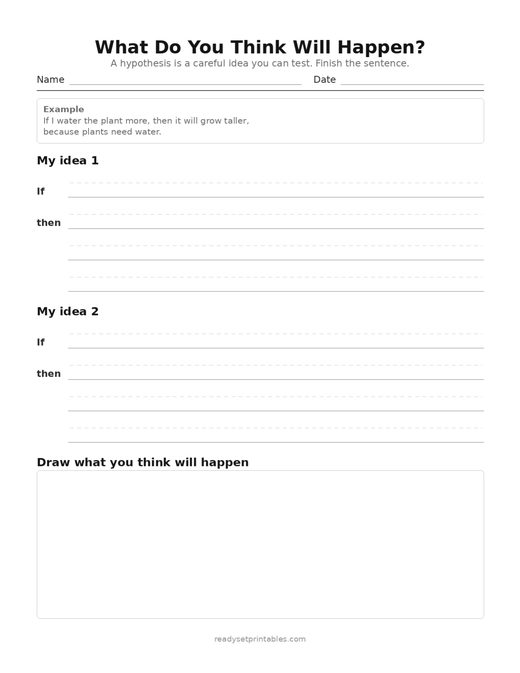 What Do You Think Will Happen? — Template (Ages 5–7)Download PDF ↓
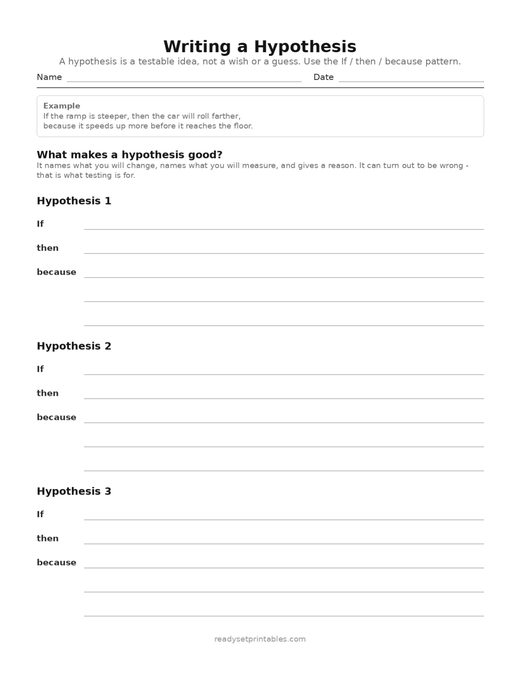 Writing a Hypothesis — Template (Ages 8–10)Download PDF ↓
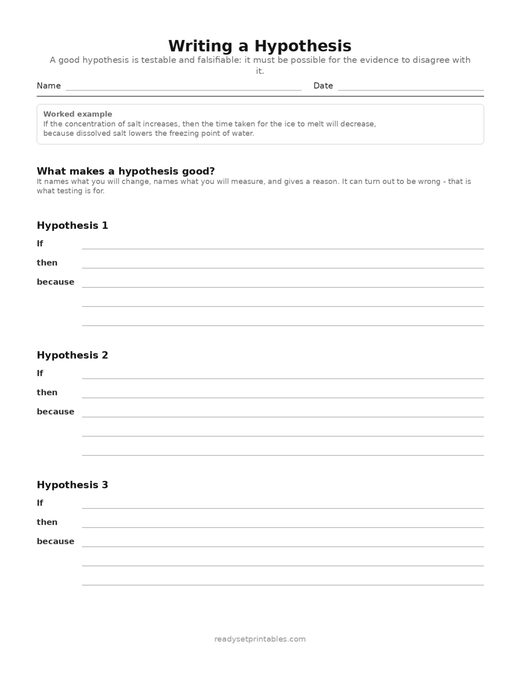 Writing a Hypothesis — Template (Ages 11–14)Download PDF ↓