Lab Report Templates
Free printable lab report templates as PDFs. Blank sections for aim, method, results and conclusion. No sign-up and no email.
⬇ Download all 3 as one PDF — free, no sign-upA lab report has a fixed shape, and most students lose marks not because the science is wrong but because the write-up puts the wrong thing in the wrong place — a result buried in the method, a conclusion that never mentions the aim. These templates give each section its own headed space so the structure is decided before the writing starts. They work for a single-period class practical as well as for a longer investigation, and they leave room for a labeled diagram, which most students forget to include.
Blank lab report sheets with headed sections for the aim or question, materials and equipment, method, results including space for a table or sketch, discussion and conclusion. Some layouts run to a second page for longer investigations; others fit one practical onto a single sheet. Ruled writing space throughout. Black and white, US Letter.
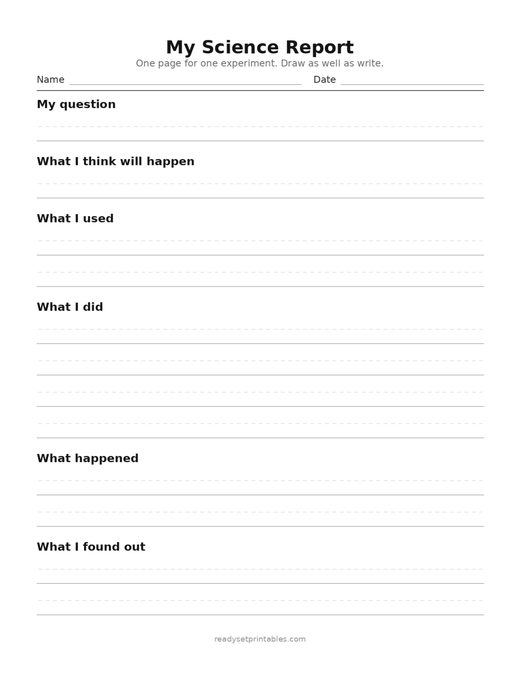 My Science Report — Template (Ages 5–7)Download PDF ↓
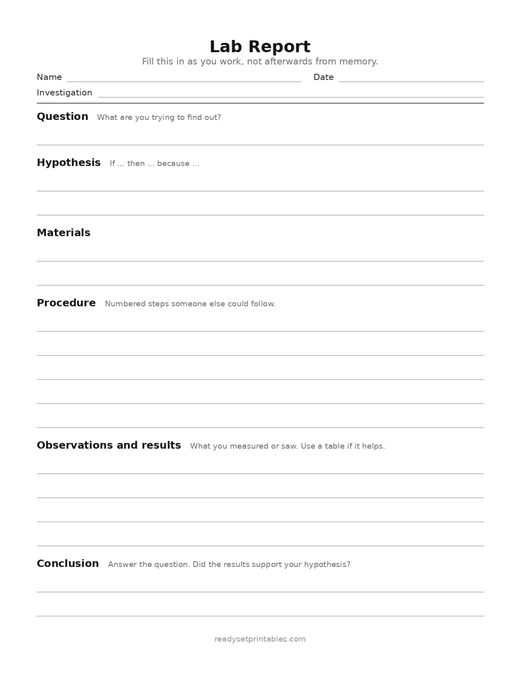 Lab Report — Template (Ages 8–10)Download PDF ↓
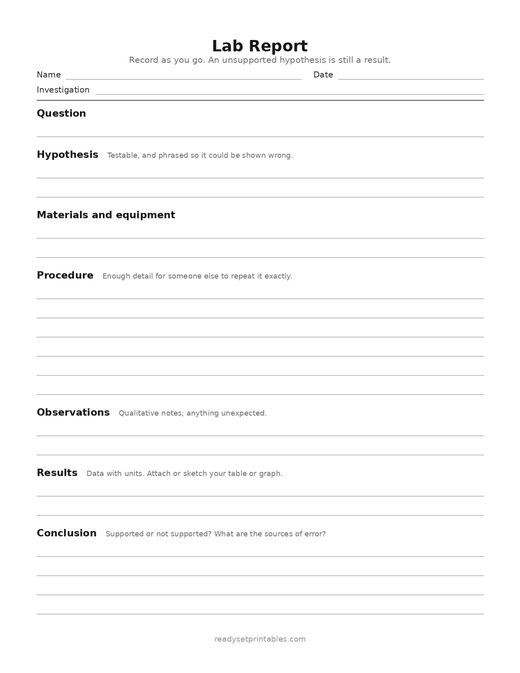 Lab Report — Template (Ages 11–14)Download PDF ↓