Science Observation Sheets
Free printable science observation sheets as PDFs. Space for drawings, notes and dated entries. No sign-up and no email required.
⬇ Download all 3 as one PDF — free, no sign-upObservation is the part of science that gets rushed, because there is nothing to calculate and it feels like waiting. A sheet with a drawing box and dated lines fixes that by making the record itself the task. These work for anything watched over time — a bean in a jar, a moon phase, a puddle drying, an ice cube melting on different surfaces — and they push students to separate what they actually saw from what they think it means, which is a distinction worth building early.
Observation sheets with a large bordered box for a labeled drawing and ruled lines beneath for written notes, plus fields for the date and time so repeated observations can be compared. Some layouts split a page into several dated panels for tracking change across days; others give one observation a full page. Black and white, US Letter.
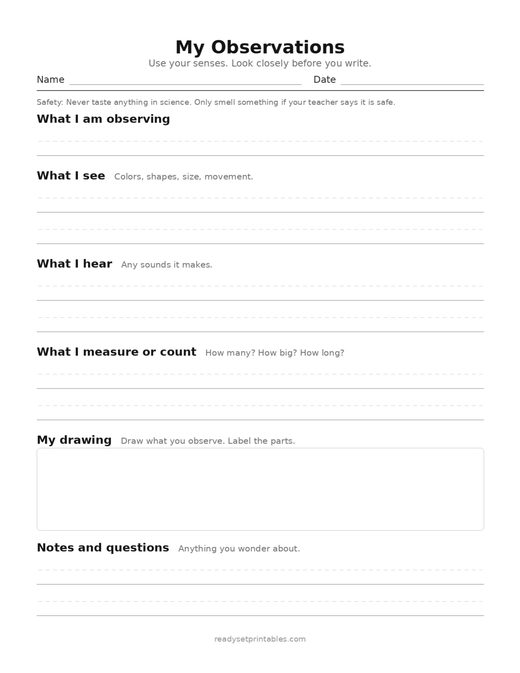 My Observations — Template (Ages 5–7)Download PDF ↓
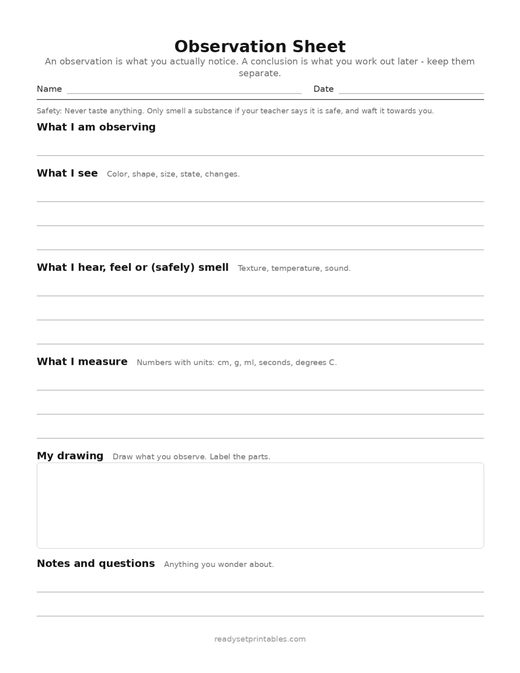 Observation Sheet — Template (Ages 8–10)Download PDF ↓
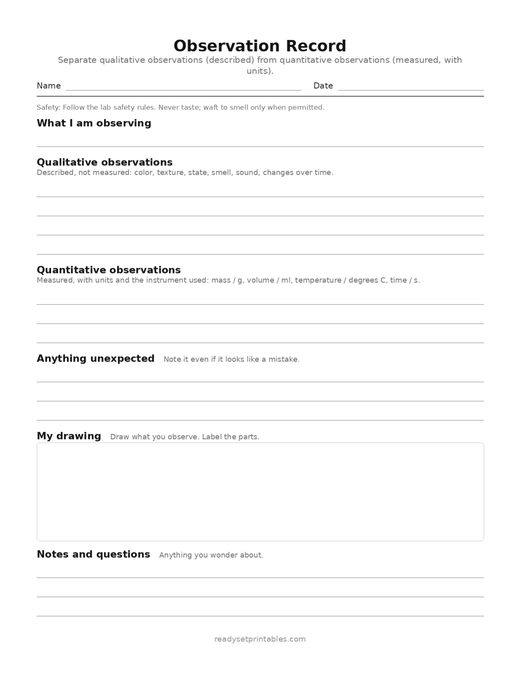 Observation Record — Template (Ages 11–14)Download PDF ↓