Scientific Method Worksheets
Free printable scientific method worksheets as PDFs. Blank step-by-step sheets for any experiment, no sign-up and no email required.
⬇ Download all 3 as one PDF — free, no sign-upThe scientific method is easy to recite and hard to actually follow, which is why a blank sheet with the steps already laid out does more good than a poster of them. These worksheets walk a student from the question through the hypothesis, the procedure, the results and the conclusion, giving each step its own labeled space so nothing gets skipped or collapsed into a paragraph of narrative. They are deliberately subject-neutral: the same sheet works for a plant growth experiment, a paper airplane trial or a kitchen chemistry demonstration.
Blank scientific method sheets with each stage in its own bordered section — question, hypothesis, materials, procedure, observations, results, conclusion — sized so a student has real room to write rather than a single ruled line. Layouts vary in how much scaffolding they provide, from short prompts for younger students to open sections for older ones. Black and white, one sheet per US Letter page.
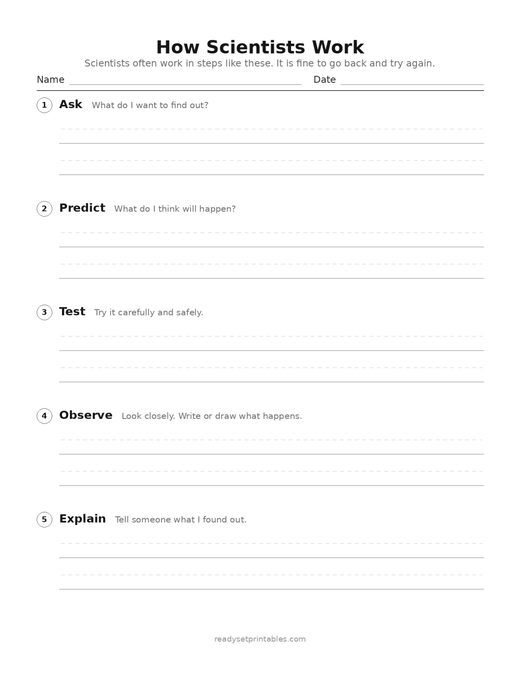 How Scientists Work — Template (Ages 5–7)Download PDF ↓
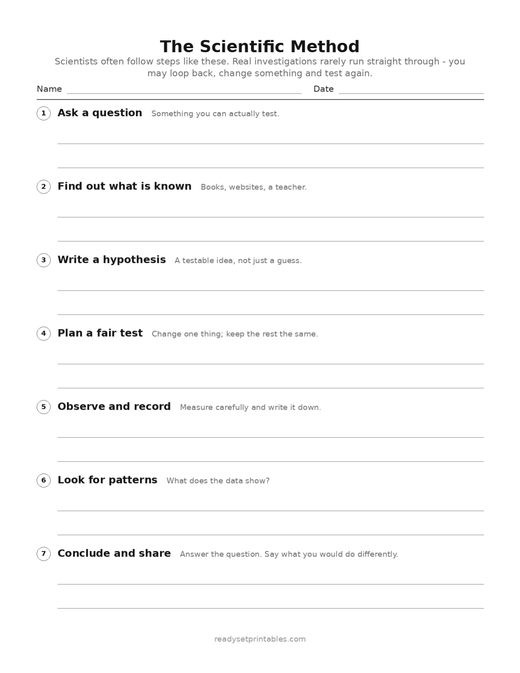 The Scientific Method — Template (Ages 8–10)Download PDF ↓
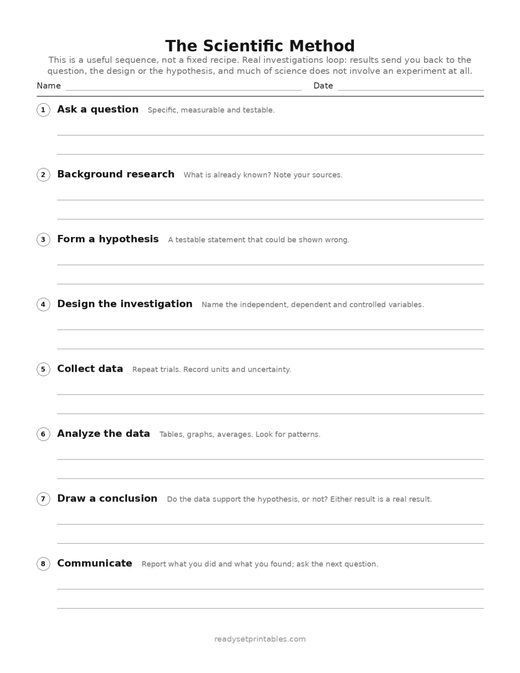 The Scientific Method — Template (Ages 11–14)Download PDF ↓