KWL Chart Templates
Free printable KWL chart templates as PDFs. Three columns for know, want to know and learned. No sign-up and no email required.
⬇ Download all 2 as one PDF — free, no sign-up- Sheets
- 2 printable PDFs
- Ages / grades
- All Ages
- Answer keys
- Not needed (open-ended / template sheets)
- Paper
- US Letter, portrait; black and white
- Cost
- Free. No sign-up, no email, no watermark
- Use
- Print as many copies as you need for your own classroom or home. Not for resale or re-hosting
A KWL chart is filled in twice, and that is the whole idea. Before a topic starts, students write what they already know and what they want to find out; afterwards they come back and write what they learned. The gap between the second and third columns is where the learning becomes visible — questions that got answered, questions that did not, and things nobody thought to ask. Printed on one sheet, it also gives a student something to hand in that shows their thinking rather than just their conclusions.
Blank KWL charts with three equal columns headed K, W and L, each spelled out in full so students do not have to remember what the letters stand for. Ruled lines run across all three columns. Some versions add a fourth column for how I will find out, useful when the chart drives a research task. Black and white, US Letter.
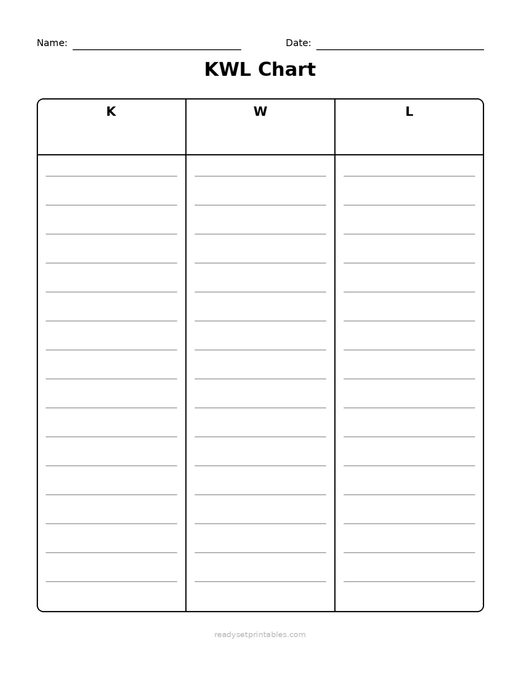 Graphic Organizers Kwl Chart BlankDownload PDF ↓
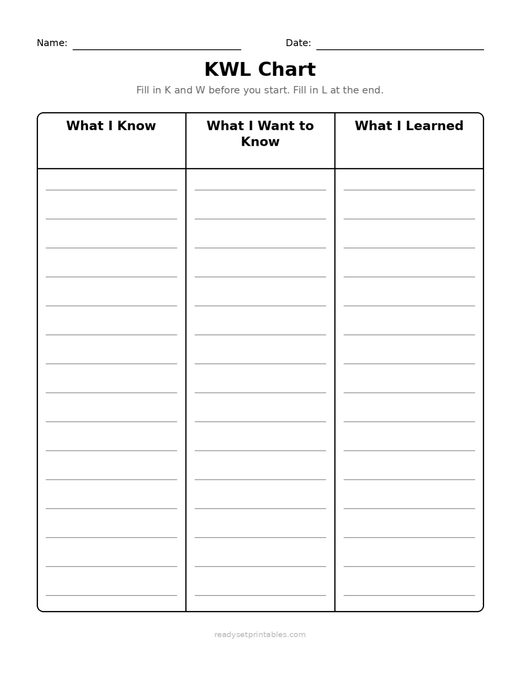 Graphic Organizers Kwl Chart PromptedDownload PDF ↓