Spider Map Graphic Organizers
Free printable spider map templates as PDFs. Blank webs with a center circle and labeled legs. No sign-up and no email needed.
⬇ Download all 2 as one PDF — free, no sign-upA spider map is the organizer to reach for when one topic has several distinct branches and each branch has its own details. The topic sits in the middle, the main ideas run out as legs, and the smaller lines off each leg hold the supporting detail. It is the shape students naturally draw when brainstorming, which is exactly why a printed version helps: the freehand version always runs out of room on the busiest leg and crams three ideas into a corner.
Blank spider maps with a central circle for the topic and radiating legs, each with short branch lines for details. Versions differ in leg count — four for a tightly focused topic, six or eight for a broad brainstorm — so you can match the template to the task rather than leaving legs empty. Lines are ruled for writing. Black and white, one map per US Letter page.
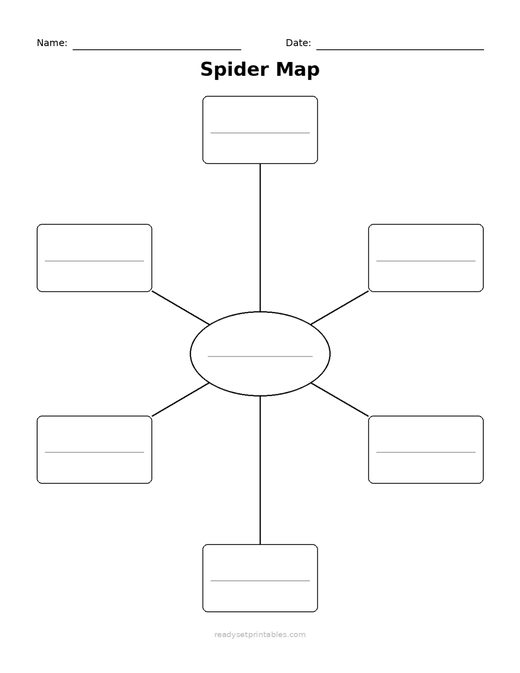 Graphic Organizers Spider Map BlankDownload PDF ↓
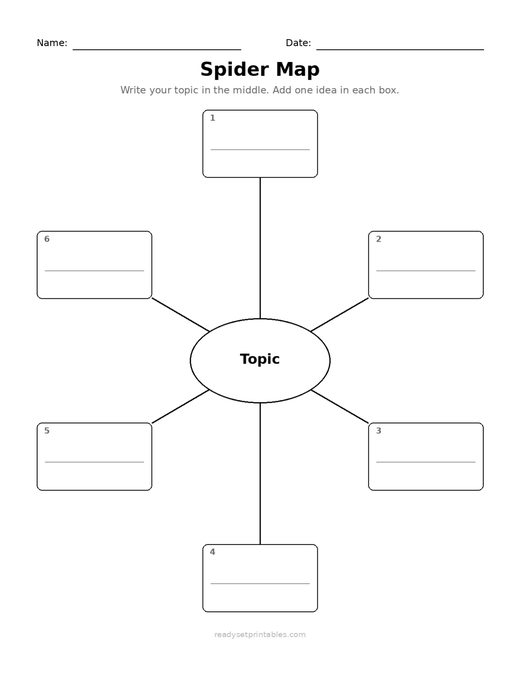 Graphic Organizers Spider Map PromptedDownload PDF ↓