Venn Diagram Templates
Free printable Venn diagram templates as PDFs. Two-circle and three-circle blanks with labeling space. No sign-up, no email.
⬇ Download all 4 as one PDF — free, no sign-upA Venn diagram earns its place when the overlap is the point. Two circles, the shared middle, and suddenly a comparison that would have been a shapeless paragraph has three clear buckets. The classic classroom problem is that students fill the outer sections and leave the middle nearly empty, because finding genuine similarities is harder than listing differences — so these templates give the intersection real room rather than the sliver you get when you draw two circles freehand.
Two-circle Venn diagrams with a generously sized intersection and a label line above each circle, plus three-circle versions for comparing three subjects. Circles are drawn large enough to write inside comfortably rather than around the edges. Some sheets include ruled lines within each region. Black and white, one diagram per US Letter page.
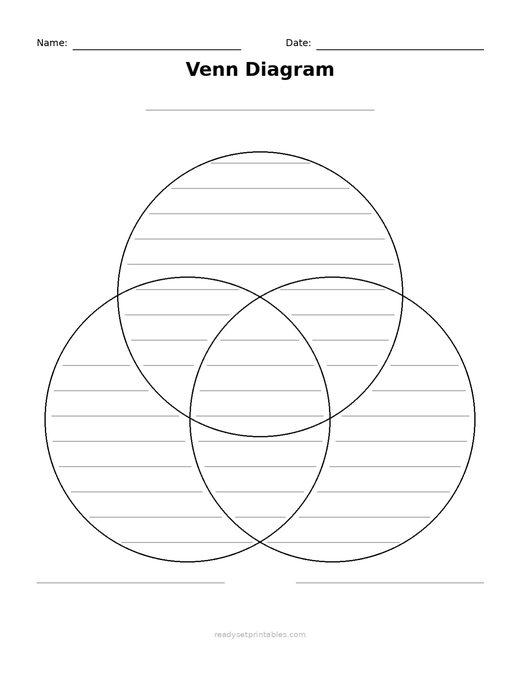 Graphic Organizers Venn Diagram Three BlankDownload PDF ↓
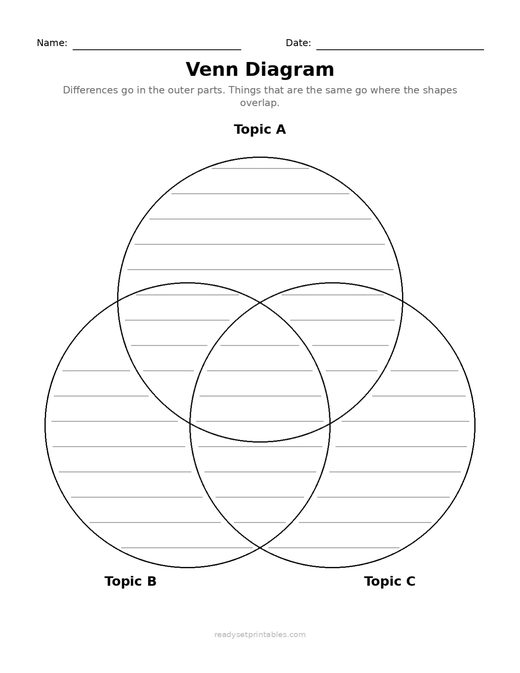 Graphic Organizers Venn Diagram Three LabeledDownload PDF ↓
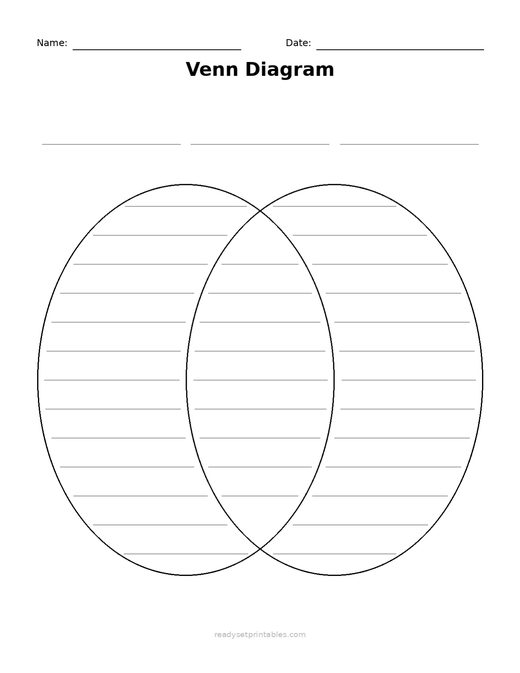 Graphic Organizers Venn Diagram Two BlankDownload PDF ↓
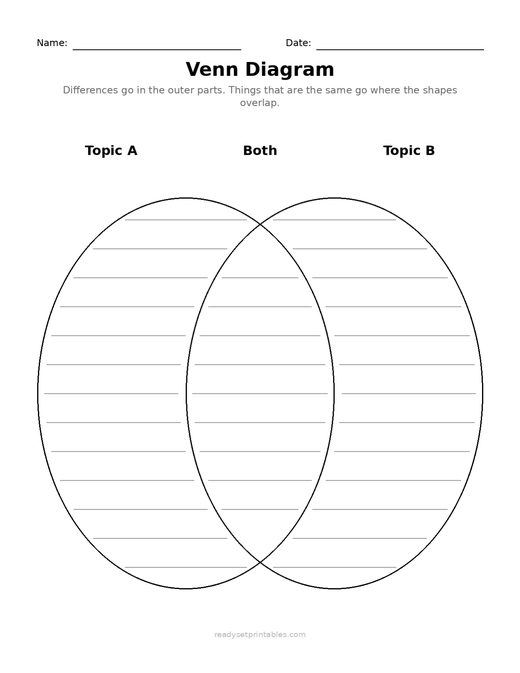 Graphic Organizers Venn Diagram Two LabeledDownload PDF ↓