Division with Remainders Worksheets
Free printable division with remainders worksheets as PDFs. Practice writing answers in the r form, plus word problems. No sign-up.
⬇ Download all 10 as one PDF — free, no sign-up- Sheets
- 10 printable PDFs
- Ages / grades
- Grades 3–5
- Answer keys
- Yes — on the last page of each PDF
- Paper
- US Letter, portrait; black and white
- Cost
- Free. No sign-up, no email, no watermark
- Use
- Print as many copies as you need for your own classroom or home. Not for resale or re-hosting
Remainders are where division stops being tidy, and where a lot of students first have to think about what an answer means. Twenty-three children into groups of four gives five remainder three — but whether the answer is five groups, six groups or five and three quarters depends entirely on what the question was about. These sheets cover the mechanics first and then push into that interpretation, because a student who can calculate a remainder but cannot decide what to do with it will still get the word problem wrong.
Straightforward division questions where remainders occur, written in the quotient-and-remainder form, with sheets progressing from single-digit divisors to larger ones. Later pages include word problems where the remainder has to be interpreted — rounded up, discarded, or kept as the answer. Clear layouts with room to work. One worksheet per US Letter page, black and white.
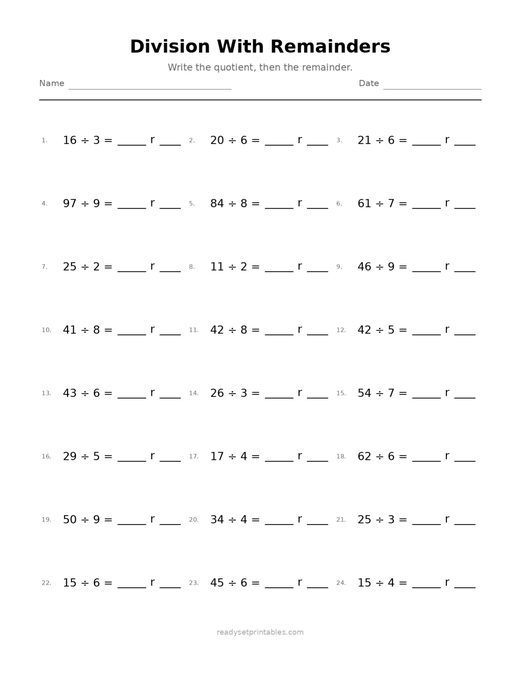 Division with Remainders 01Download PDF ↓
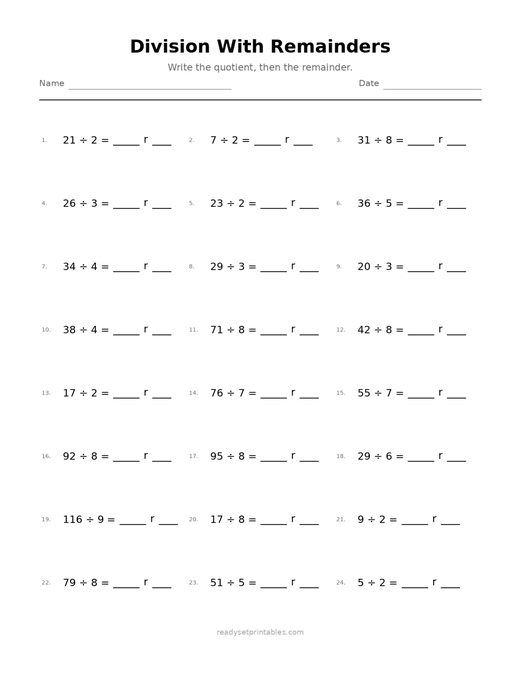 Division with Remainders 02Download PDF ↓
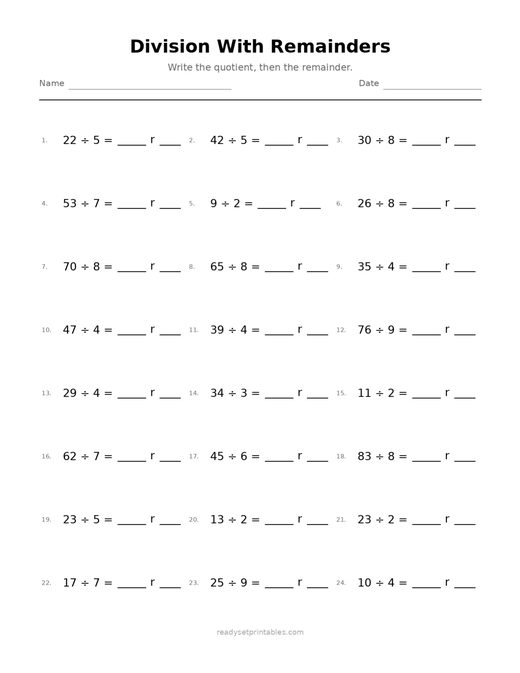 Division with Remainders 03Download PDF ↓
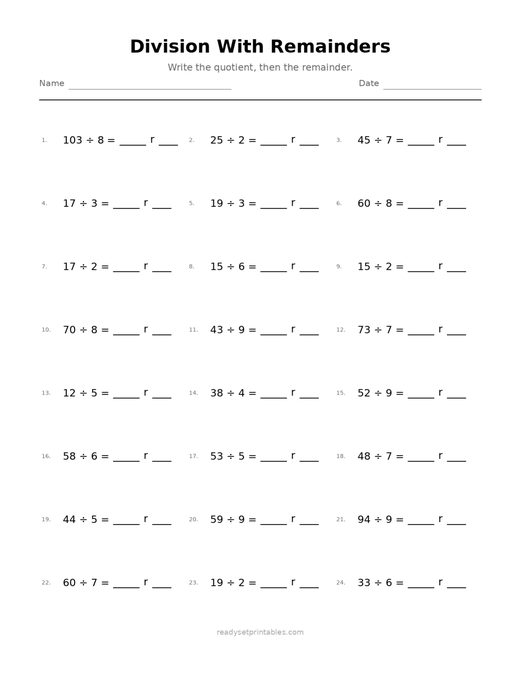 Division with Remainders 04Download PDF ↓
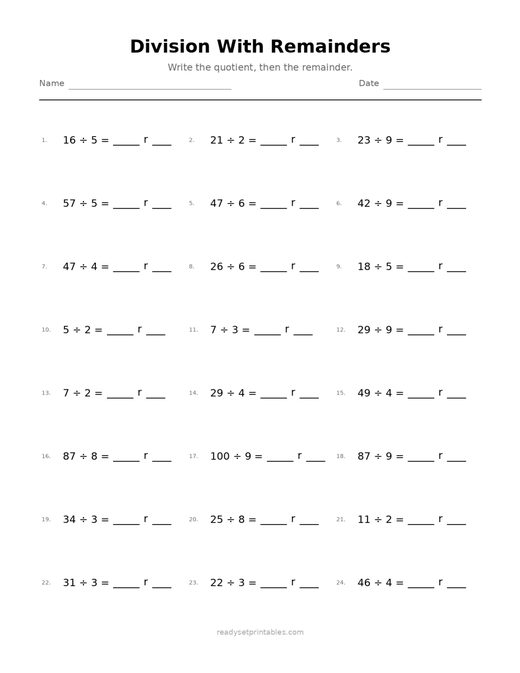 Division with Remainders 05Download PDF ↓
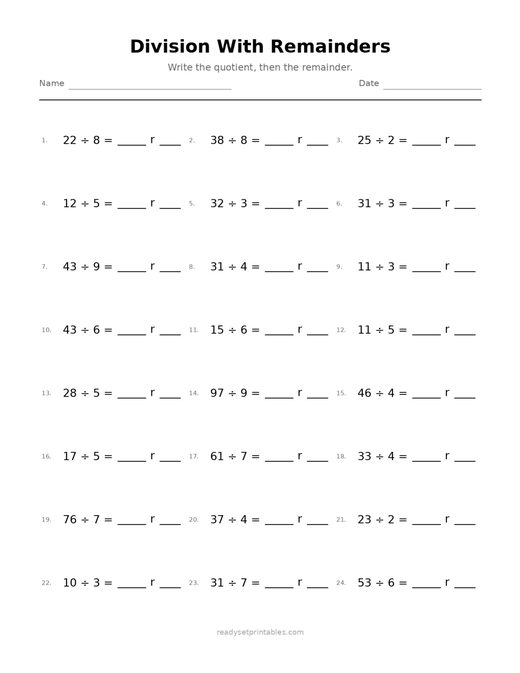 Division with Remainders 06Download PDF ↓
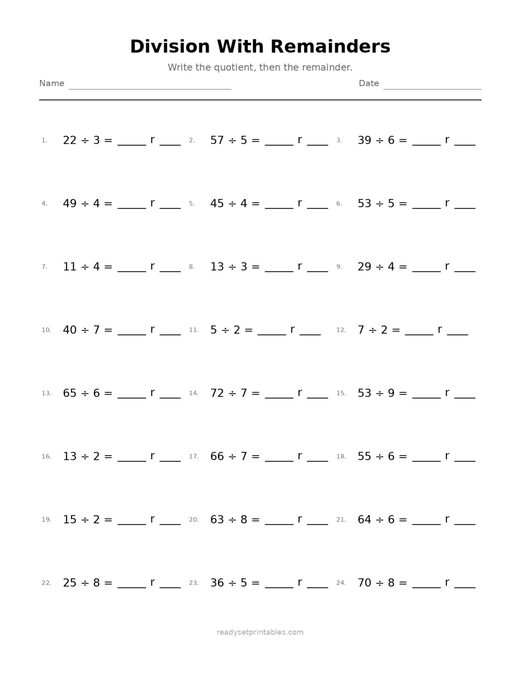 Division with Remainders 07Download PDF ↓
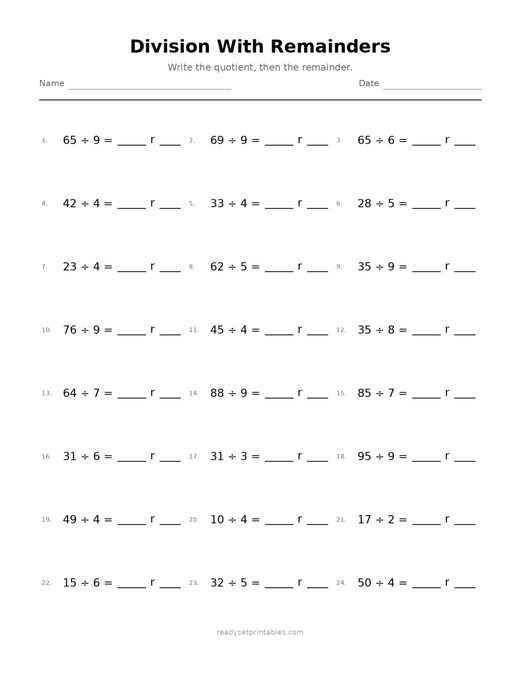 Division with Remainders 08Download PDF ↓
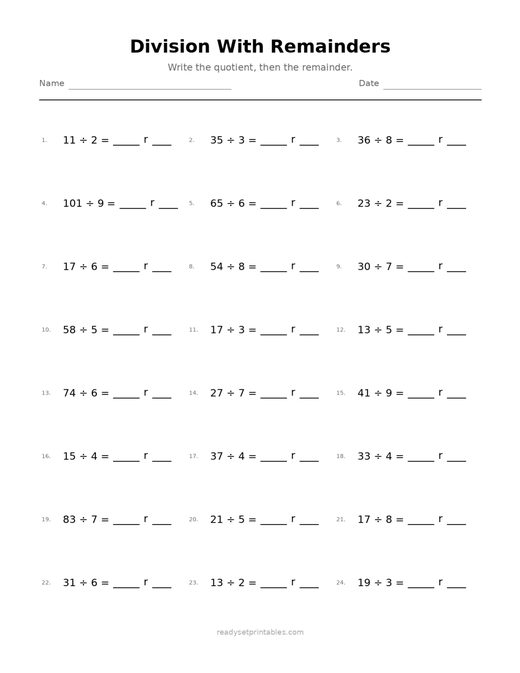 Division with Remainders 09Download PDF ↓
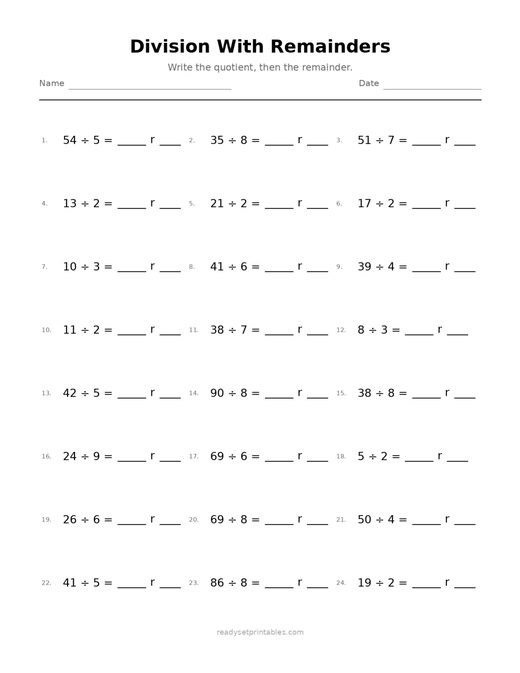 Division with Remainders 10Download PDF ↓